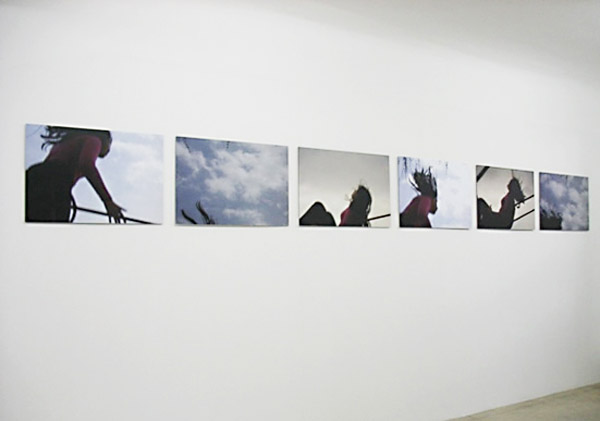
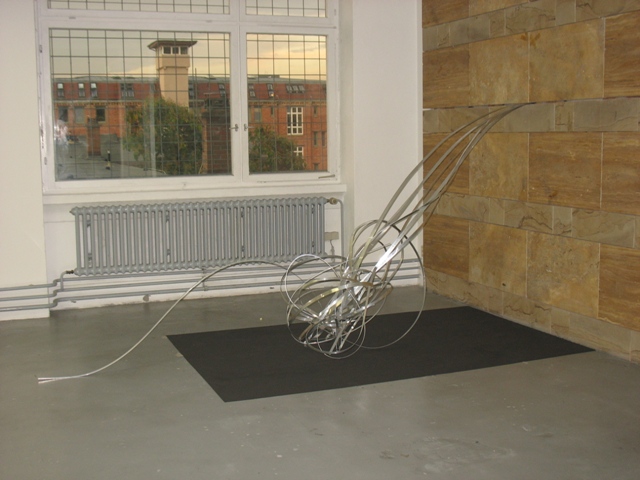
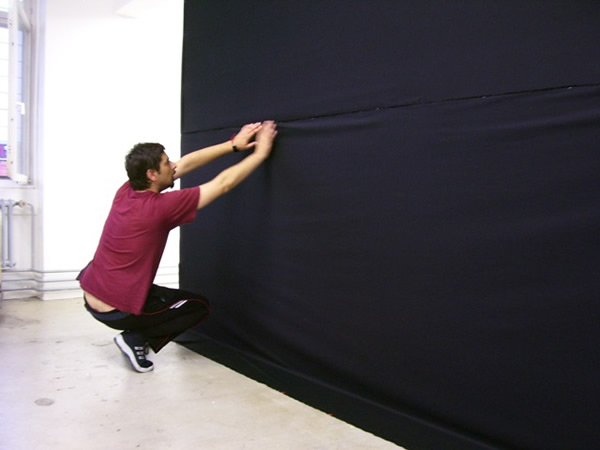
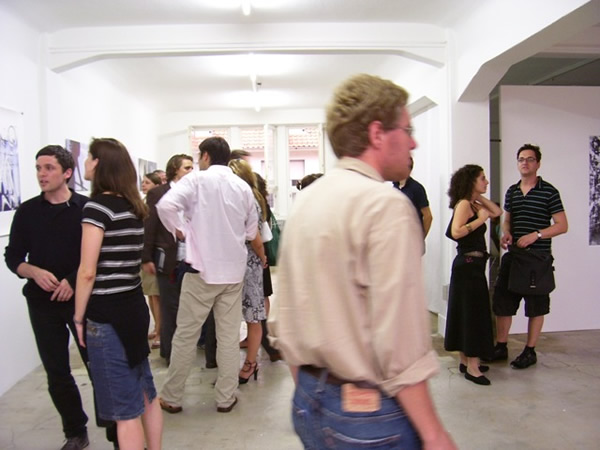
TIPIC_NO, Kunstlerhause Stuttgart, 8. September – 23. September, Stuttgart, Germany.
Our friend Tayfun Kesgin, head of music production label called Yaman from Sarajevo, with wich we collaborate many times before, connected our group with young and ambitious Art historic and curator Sabina Husicic. Now based in Stuttgart, her origin is from Bosnia&Herzegovina, she get in Germany as a refuge and has had hard time while she were finding ways to finance her studies in Art history department at famous Academie de Solitude in Stuttgart. She is now succesfull in her own, and she had idea to show some Art from her country which was not established yet. She did exploring, and from whole country she finally heard about Visionary Society and our Barake project. When she saw our works she was completely charmed by its proud and strong attitude, by its freedom in expression, originality and diversity from current art discourses in the world in that moment. Shortly after her visit we agree to make an exhibition in Stuttgart. She arranged things and funding, and was succeed in getting avantgarde art house and place very well known place in art world, famous Kunstlerhaouse. Exhibition was titled TIPIC_NO. Small word game which meaning was ideal match for our art practice and working methods at that time.
Artists:
Ervin Babic, Christiana Biron, Leila Cmajcanin, Sead Kadribasic, Samir Fejzovic, Muhamed Begic, Emir Kapetanovic, Demis Sinancevic.
Curated by:
Sabina Husicic
Curator’s statement:
TIPIC_NO exhibition presents contemporary art of young artists group Vizionarsko Drustvo from Sarajevo. The title (in German: typically) is an ironic allusion to the demand of the foreign art market, a special characteristic of art from Bosnia and Herzegovina to export the so-called”war art”. Can the young artists of the multi-ethnic Balkan state also be “typical normal” artists who deal with the issues which they see as important? Is a different view allowed and will it be accepted? The Dayton Peace Agreement was signed more than ten years. In no other country is, however, the association of war in the minds of people so pronounced as at the thought of the multi-ethnic country of Bosnia and Herzegovina. The link is entitled: The relics of the war are both in the socio-economic structures of the country feel as well as the many ruinous buildings to see. This exhibition in no way negates the so-called “war art”, because it is also a part of the reality of the country. The exhibition aims rather to show that even a self-conscious young generation of artists exists, not only as a “war art” want to be perceived.
Christiana Biron continues in its work primarily with the unique Multiethnic the small European country apart. In her photo series "Dancing Gypsy Girls" and in their magical “fable animals – collages” suspend the issue of diversity of peoples in a playful way around. Demis Sinancevics works are ironic allusions to the current political and economic situation of the country. The artist works primarily with simple means insignificant and reduces its work on the “essence”. The artist Edin Vejselevic juggles cleverly with various branches of art, his works move between spatial-body performance installations. In his photography - triptychs he uses the various works into a new relationship to each other and thus changed to a certain extent, the original intention of his work. The humorous treatment of the respective subjects will always receive. Kapetanović deals with in his works of history. The future looks different if the past is re-defined? Is the memory erase? The artist Ervin Babic is in his work "1km" (currency of the country of Bosnia and Herzegovina: Konvertibilna Marka) always a new with the meaning of the value or the worthlessness apart. The analysis of the visual experience plays in Jasmin Durakovics Photographs play an important role. His photo series "Blind Girl" is a confrontation with the "vision" as not only physically meaning visual perception, but also a psychological and mental experience. Leila Cmajcanin’s graphics are mysterious depictions mystic figures. The template for their work takes the artist taking out of their social environment, which then artistically deformed. Muhamed Begics and Samir Fejzovics room installations are newer-measure and conversions of already-existing objects, which thus get a new functionality. Kadribasics cryptic black - white graphics play with the ambiguity of the characters. It avails itself of the artists of both the symbolic visual language as well as the enigmatic signifier of title.
Thanks to:
Sabina Husicic
Kunstlerhaus gallery crew and its all members and workers,
Sabina’s mother for 3 great lunches,
Brankica,
Ervin Babic,
Futku.
Support:
Kunsterhaus Stuttgart, Sabina Husicic, Bosnian&Herzegovinian Consulate in Munich, Touring.